
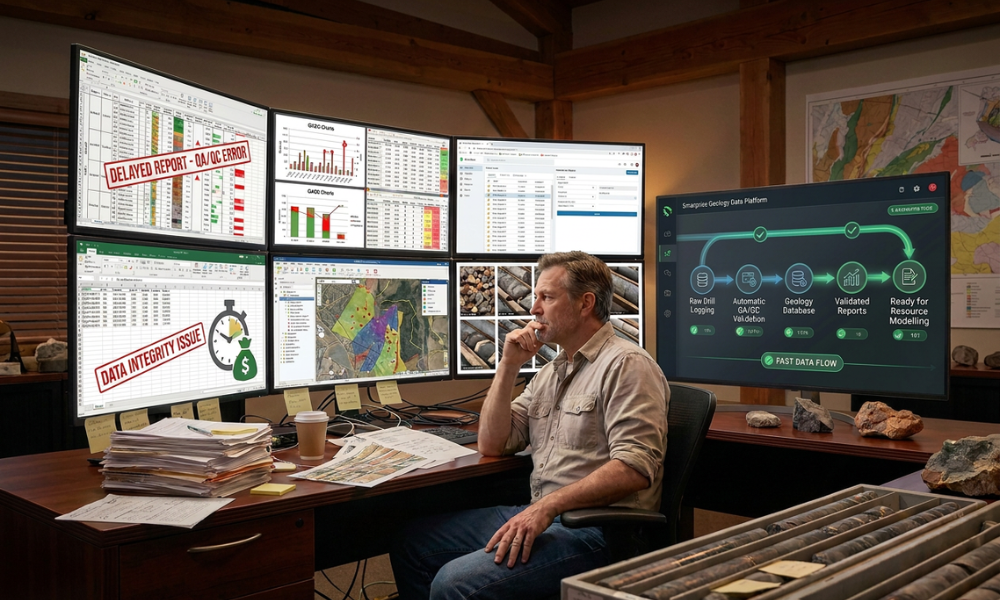

Most geologists spend three weeks doing what should take three days.
Not because they’re slow. Not because they’re bad at their jobs. It’s because the tools they’re using were never built for speed, and somewhere along the way, the industry just accepted that as normal.
It’s not normal. And it’s costing mining operations far more than most managers want to count.
Here’s what’s really going on, and what the best geology teams are doing differently.
The Hidden Cost of “Good Enough” Data Workflows
Every week a project is delayed because of data admin is a week of revenue sitting on the table. Every report that takes four days instead of one is four days of a senior geologist’s time spent on formatting, not geology.
The mining industry runs on precision. But precision without speed isn’t a competitive advantage. It’s a liability.
The teams winning right now aren’t the ones with the most experienced geologists. They’re the ones who’ve removed the friction between raw data and actionable output. They’ve stopped doing manually what a modern platform does automatically.
The gap between those two types of operations? It’s not talent. It’s infrastructure.
5 Signs Your Data Workflow Is Broken
1. Reports take longer than the project itself.
If your team spends more time formatting and reformatting data than interpreting it, that’s not a process problem. It’s a platform problem. Geological data should move fast from collection to output. If it doesn’t, something is wrong upstream.
2. You rely on one person who “knows the system.”
Single points of failure aren’t workflows. They’re risk. When one person holds the tribal knowledge of how your data is structured, you’re one resignation or sick day away from a crisis.
3. Every new project starts from scratch.
No templates. No version history. No continuity between projects. If your team rebuilds the same database structure every time, you’re paying for the same work over and over.
4. You’re still paying consultants for work your team should own.
External consultants have their place, but if you’re outsourcing data management tasks because your internal platform can’t handle them, that’s a gap your software should close, not your budget.
5. Data errors only surface after the damage is done.
Inaccuracies at the logging stage compound. By the time an error shows up in a final report, or worse, in front of a client or investor, the cost is already much higher than catching it at the source.
If two or more of these sound familiar, you’re not alone. They’re the five most common pain points we hear from geologists and mine managers across Australia and beyond.
What the Best Mining Teams Do Differently
The operations that consistently deliver faster, more accurate results aren’t working harder. They’ve standardised their data infrastructure around a platform that handles the heavy lifting.
That means:
- Faster database setup: hours, not days, with drillhole data entry built for the way geologists actually work
- LAS data managed in a fraction of the usual time, without manual reformatting steps
- Charts and QAQC outputs produced directly from raw data, with no intermediate steps and no reformatting
- Full team access on one platform, so no one person becomes a bottleneck
- Complete version history and change logs, so data is never lost and every edit is traceable
The result isn’t just faster reports. It’s a team that operates with confidence, because they know their data is accurate, their workflows are repeatable, and their outputs will hold up to scrutiny.
That’s what builds a reputation in mining. Not years of manual experience with clunky tools. Speed, accuracy, and consistency, delivered every time.
Near-Perfect Data Accuracy in 60 Days, Without Starting From Scratch
The barrier most mining teams cite when they look at changing their data platform is time. “We don’t have the bandwidth to learn a new system right now.”
Here’s the reality: the bandwidth you don’t have is being consumed by your current system. Every week you stay on an inefficient workflow is a week of avoidable cost.
1point is a geology database platform built specifically for mining professionals who are done with slow, fragmented data management. Most teams are fully operational within 60 days, and the shift in output quality is immediate.
No lengthy onboarding. No PhD required. Just a platform that works the way you do, so you can focus on the geology, not the admin.
The Bottom Line
Your data platform should make you faster, more accurate, and easier to trust. If it’s doing the opposite, slowing your team down, creating errors, or making you dependent on external help, it’s not a feature gap. It’s a strategic problem.
The good news: it’s fixable. Quickly.
Ready to see what 60 days looks like for your operation?
Book a free demo at floutsoftware.com. No lock-in, no lengthy sales process. Just a look at what’s possible when your data platform actually works for you.
1point is a geology database platform by Flout Software, built for real-time logging and manipulation of geological data for mining professionals. Deployed across 13 businesses and 40+ active users across Australia.